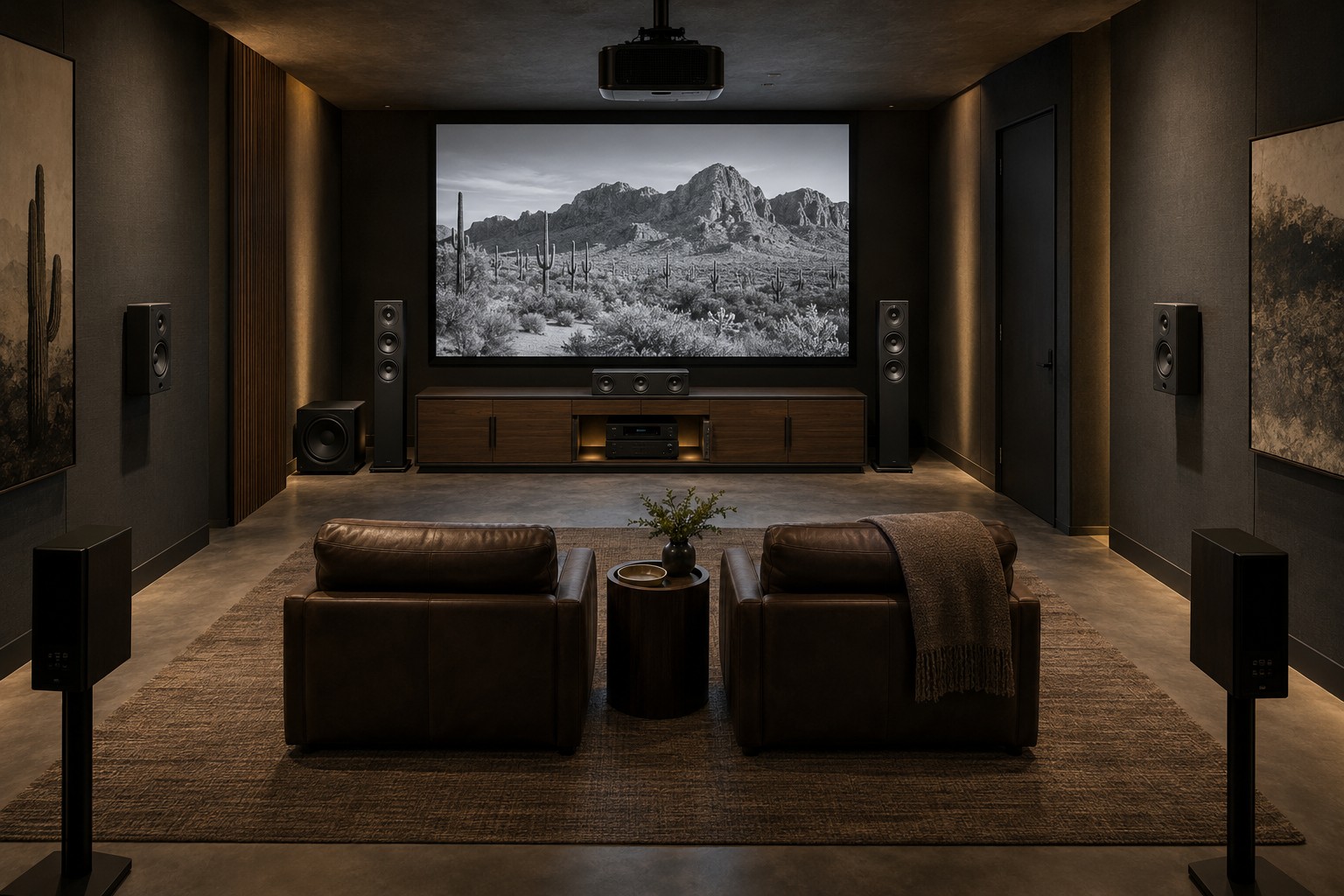
A projector can make a movie feel like an event, but a large image is only useful if it works when you actually watch. For a Greater Phoenix room used for afternoon sports as well as evening movies, start with daylight and viewing habits before choosing between a projector and a TV.
As a planning rule, a room that stays bright during normal use is a good reason to evaluate a TV first. A room where you are willing and able to control the light deserves a serious projector comparison. Neither choice should be made from screen size alone.
Describe a normal afternoon and movie night
Write down when the room is busiest. Will people watch a game with the shades open, leave lights on while talking, or darken the room for a film? Include the viewing habits of everyone in the household.
In a Phoenix home, look at the proposed display wall at the time you usually watch. Note direct sunlight, bright windows reflected in the viewing area, and light from an adjoining kitchen or hallway. A room that looks suitable during an evening consultation may behave differently during an afternoon game.
Take photos from the main seats with the window coverings in their normal positions. Then repeat with the light control you would realistically use. This gives the display discussion a concrete starting point.
Consider a TV first when daylight stays part of the room
If you want casual daytime viewing without changing the room each time, compare suitable TV models before committing to projection. That is a practical recommendation about how the room will be used, not a guarantee that every TV handles bright conditions equally well.
Check reflections from the main seats and from side seating. Compare the actual models with the content you watch, and discuss whether a different wall position or shade arrangement would help. Do not assume a display’s brightness specification settles every glare problem.
PHE’s premium TV installation service is a starting point for a display and audio plan suited to the room.
Evaluate a projector as a room and screen combination
Projection deserves consideration when a larger image is a priority and light control can be part of the experience. Epson explains that ambient light affects projectors and identifies the amount of light you can control as an important selection factor. Its guidance also connects projector placement to screen width and the model’s throw ratio. Epson home projector planning guidance
Ask to compare the proposed projector and screen at the intended image size, with lighting that represents your room. Include familiar darker scenes and daytime sports, rather than judging only bright demonstration clips.
A lumen number is one input to that discussion. It does not replace checking the screen, room lighting, seating and selected picture settings together. Avoid choosing a projector by a single brightness threshold copied from another room.
Understand what an ambient light rejecting screen is meant to do
An ambient light rejecting, or ALR, screen may be worth evaluating when some room light remains. It still needs to be selected for the proposed projector and installation.
For its V5000i, V5010i and V7050i TV projectors, BenQ recommends an ALR screen in well-lit environments while noting that darker environments still provide better visual quality. That is useful guidance for those models, not proof that any ALR screen makes every projector suitable for any bright room. BenQ guidance on TV projectors with the lights on
Ask the installer to identify the exact screen material and projector pairing. Check the view from side seats as well as the center, and discuss the direction of the room’s light. If window coverings are part of the plan, decide whether you are comfortable using them for normal viewing.
Check placement before choosing the biggest image
Mark the proposed image outline on the wall and assess it from the seats you use most. Include nearby doors, artwork, speakers and furniture. A larger image should fit the seating and room layout rather than simply fill every available inch.
For projection, confirm the model-specific mounting position, image adjustment limits, ventilation and service access. A short-throw or ultra-short-throw design has its own placement requirements; have the actual product dimensions and instructions checked before cabinetry is ordered.
For a TV, review the mounting arrangement, connection access and viewing position together. Either approach also needs a plan for power, signal cables, sources and audio. PHE’s home theater installation service can frame the conversation around the full viewing experience.
Compare the complete daily routine
Ask what happens when someone wants to watch: which display and audio components turn on, whether shades need adjusting, and how the source and volume are selected. Discuss the steps another household member will use without help.
Compare proposals that describe the complete installation scope, including the display or projector and screen, mounting, audio, wiring access and any planned controls. Keep electrical work, cabinetry and finish repairs clearly assigned. A useful comparison covers the finished room, not only two equipment prices.
Explore PHE’s AV integration approach and control system planning when several components need to work together.
Discuss your Phoenix viewing room with PHE
Send photos of the display wall, windows and seats, along with room dimensions and the times you usually watch. Mention whether you want to keep daylight in the room or are open to a darker movie setting.
Request a Quote to discuss a projector or TV installation planned around your Greater Phoenix home and everyday viewing.